Friday Failure Lecture + Takeaways

If at first you don’t succeed, failure may be your style

Quentin Crisp
(English writer & actor)

During our lecture on Friday, Benji mentioned this podcast by Elizabeth Gilbert on creative genius / failure and I was really interested. I think Gilbert’s point that creativity needs to be almost externalized to protect the artist’s mental health/ego is really relatable.

…because writing was my home, because I loved writing more than I hated failing at writing, which is to say that I loved writing more than I loved my own ego, which is ultimately to say that I loved writing more than I loved myself. 

Elizabeth Gilbert

In another related podcast, Gilbert talks about how she loves writing more then she loves herself, and when she finds herself lost or afraid to create the one thing that always centers her is writing. Even if she is writing something terrible, she says that she at least, “showed up” and that is the best you can do sometimes. I admire this so much because its easy to say that you can’t do any work because your ideas are bad, but her philosophy is that, even if the work is terrible, she is always working and trying to create.

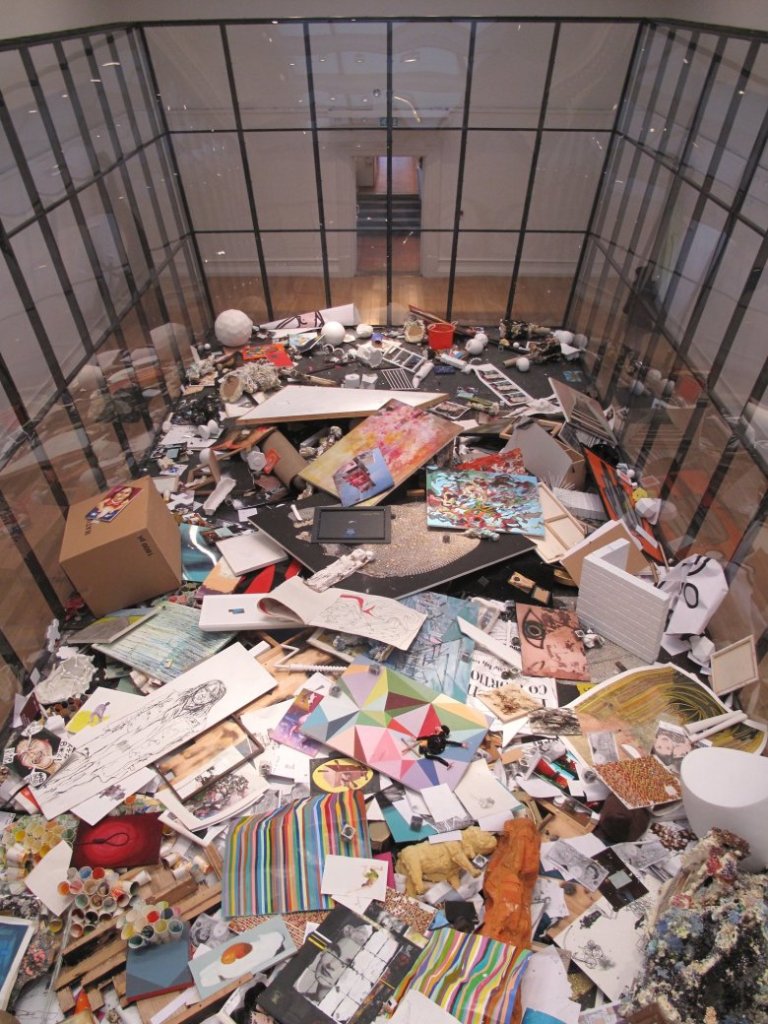
Michael Landy Art Bin

Another “failure” project I found interesting was Michael Landy’s Art bin. I liked the concept behind this, because I have so many past works that honestly need to be in the garbage, but I can’t bring myself to do it because of the amount of time that went into making those pieces.

Part of me wants to take a note from this and just destroy everything I’ve made in my past. I feel like it would be difficult to do, but at the same time I feel that some of my old works limit me and in the end I would feel cleansed. This would be a fun topic to play with over Christmas Break.

I also really like the idea of putting failures on public display. I feel like, if people actually did put their failures in the bin, it would be a humbling experience. I think it would also be a bit cathartic.
Michael Landy

Unit 1: Reflection + Future Actions

Practice/Research

  1. The performative elements to my practice have been successful in illustrating my ideas so far- continue to use and develop this (even if its just a quick, impromptu video)
  2. Try to use more innovative or haphazard ways of construction that drift away from what I have been “traditionally” taught
    • Perhaps by setting up rules for myself to follow, I can begin to let go a little bit of what is “traditionally” correct
  3. Research restricted codes of conduct, systems that enforce a rigid “way of doing things” (like traditional crafts even), and restricted access to specific groups of people (perhaps looking at Helen Hamlyn center for design- aging exhibition.

Portfolio

  1. Have a chat with Julian to confirm if I should apply in November or January
  2. Connect elements of research directly to practice, and overall use more research in lieu of descriptive writing
  3. Revisit old work and connect it more to my current journey (I’d like to do this in a creative way-I need to think on this a bit more and get some suggestions)
    • my initial thought is to use one of the time consuming methods that I did in the past and create a multiple hour video of me doing this (maybe looking at how I develop my own meticulous practice; micro processes; the discomfort of an endless task; absurd approaches).

Final Presentation Notes and Thoughts

In case you missed my video, here it is again!

I felt like my own personal work was not as strongly addressed during the final critique, but a lot of the feedback given was applicable to every group member. For example, Lee and Nathan both pointed out that we shouldn’t have established, “nature” as the definition of authentic. This was a good point, and I felt like my group could have spent more time defining what exactly authenticity is. I did not really even think about that because it just seemed like a fact that I would accept.

I felt like we did not communicate the fact that our response to the manifesto was not to take a stance on whether or not advertising is good or bad, but rather to promote the idea that consumers should be more aware of advertising. I felt like that didn’t come across, and we could have stated that more clearly.

In reference to my own work, I learned so much in this process, and I’m really just irritated that I did not get started sooner. ITS NOT ENOUGH TO JUST RESEARCH OR JUST MAKE, doing both AT THE SAME TIME is what has elevated the quality of my thinking and design skills. Researching and exploring multiple different avenues of experimentation at the same time was so crucial to my process. Had I realized this sooner, I think my work would have been more interesting because I would have been able to get more feedback (and have more time to take videos/cut clips together).

I’m really happy with how much I have learned, and I’m so excited to apply these skills on the next project.

Design a site like this with WordPress.com
Get started