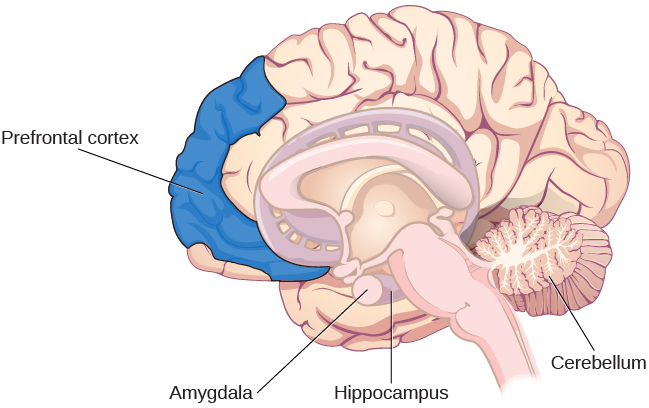
The main parts of the brain involved with memory are the amygdala, the hippocampus, the cerebellum, and the prefrontal cortex.
amygdala: The main job of the amygdala is to regulate emotions, such as fear and aggression. The amygdala plays a part in how memories are stored because storage is influenced by stress hormones. For example, if somebody hears a beeping sound before they are shocked multiple times in a row, their body might physically respond to help brace themselves- this fear response is due to the amygdala. Because of its role in processing emotional information, the amygdala is also involved in memory consolidation: the process of transferring new learning into long-term memory. The amygdala seems to facilitate encoding memories at a deeper level when the event is emotionally arousing.
hippocampus: the hippocampus is involved in memory, specifically normal recognition memory as well as spatial memory (when the memory tasks are like recall tests). Another job of the hippocampus is to project information to cortical regions that give memories meaning and connect them with other connected memories. It also plays a part in memory consolidation: the process of transferring new learning into long-term memory.
The Cerebellum and the Prefrontal Cortex:
Cerebellum and Prefrontal Cortex: Although the hippocampus seems to be more of a processing area for explicit memories, you could still lose it and be able to create implicit memories (procedural memory, motor learning, and classical conditioning), thanks to your cerebellum.
Neurotransmitters: There also appear to be specific neurotransmitters involved with the process of memory, such as epinephrine, dopamine, serotonin, glutamate, and acetylcholine. It believed that strong emotions trigger the formation of strong memories, and weaker emotional experiences form weaker memories; this is called arousal theory.
Personal Take
What struck me about this research into the physiology of memory is how tied memory is to emotions. Manipulating memory is something that would be very very difficult (without severely injuring somebody), so I am interested in recording and collecting emotional responses.
This research reminds me of my favorite quote by Maya Angelou:
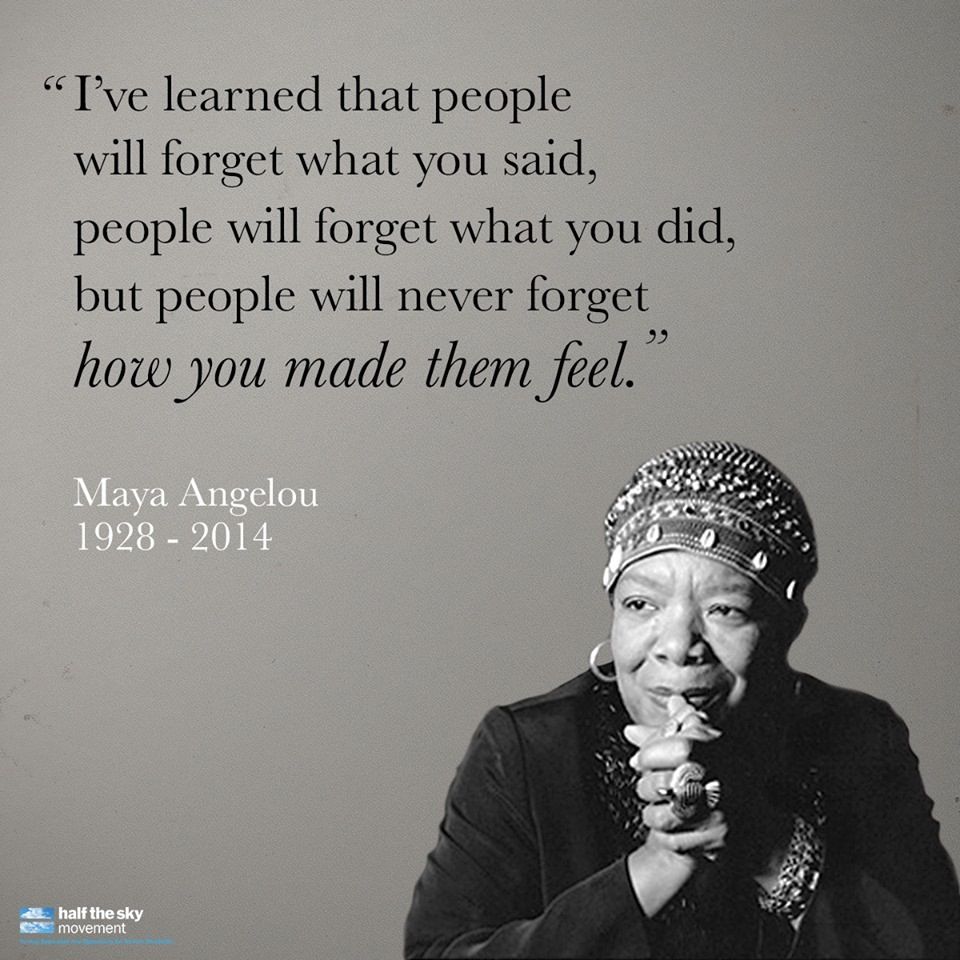
I’m going to discuss this in the tutorial on Tuesday, but I am still attached to the idea of using stitching as a way to represent these emotions. I know cathartic experiences have strong ties to memory (view next post).
Maybe I will let people stitch their best or worst memory with whatever colors/shapes they want and only give them 20 minutes to do so, and see what associations with colors and shapes I can make.
I could also give them a little library of stitches to choose from if they need help expressing themselves through stitching.
Citations
Parts of the Brain involved with Memory | Introduction to Psychology. Lumen. < https://courses.lumenlearning.com/wsu-sandbox/chapter/parts-of-the-brain-involved-with-memory/ > [23 November 2019].
 Samantha's RCA Process